.png)
Hardware prices have climbed significantly
The graph below illustrates the general market trend for storage and memory pricing over the last 18 months.
Illustrative trend in storage and memory pricing
Indexed market trend (Jan 2025 = 100). Based on industry pricing trends reported by semiconductor market analysts.
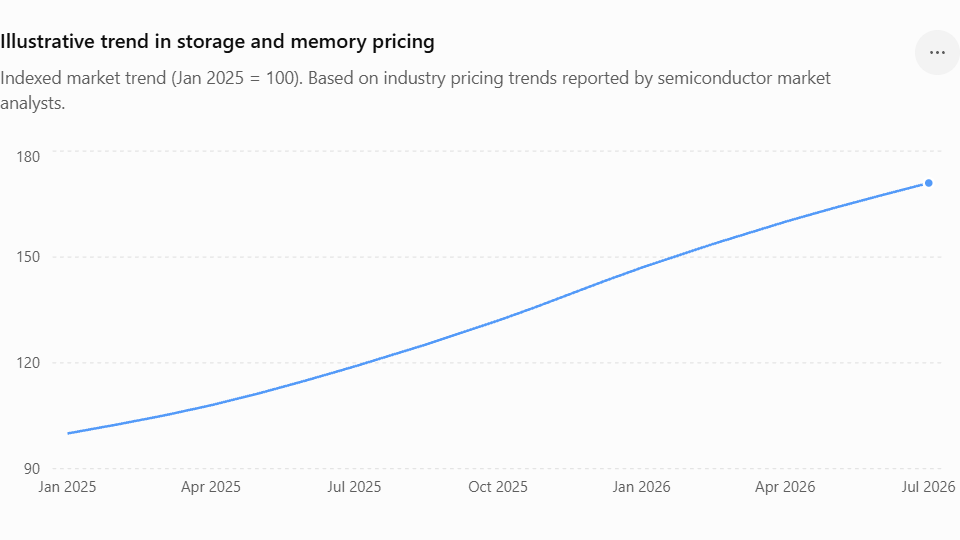
Although exact pricing varies by manufacturer and component, the overall direction has been consistent across the industry.
Typical component price increases over the past 18 months
Illustrative ranges observed across the PC hardware market.
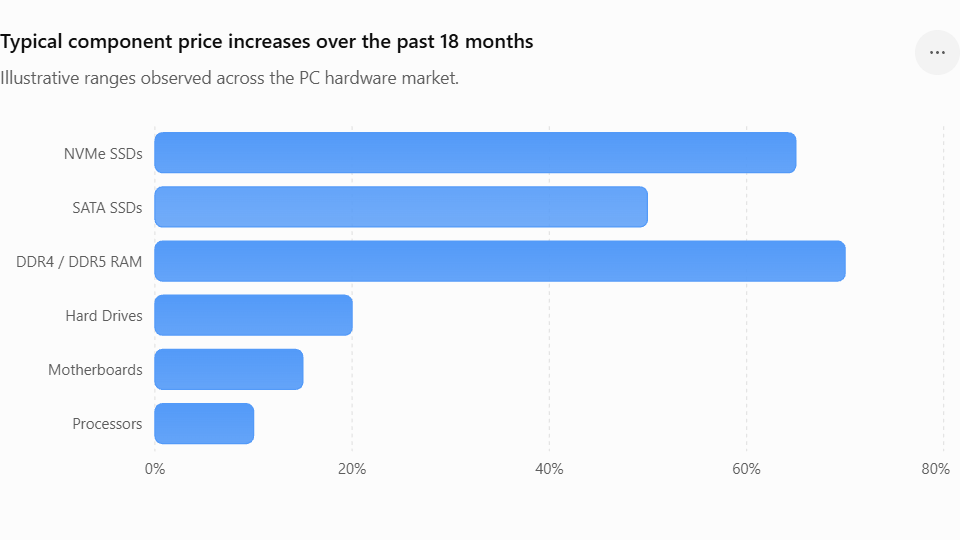
The biggest increases have been seen in:
- SSD storage
- System memory (RAM)
- Enterprise-grade storage used in servers
Why has this happened?
Several global factors have combined to increase hardware prices.
AI has dramatically increased demand
Artificial Intelligence has created unprecedented demand for high-performance memory and flash storage.
The same memory chips used in business laptops and desktops are also used in AI servers and cloud infrastructure. As hyperscale data centres expand, manufacturers naturally prioritise these higher-value markets.
Manufacturers reduced production
During the slowdown in 2023, memory manufacturers intentionally reduced production because demand had fallen.
When business demand recovered—and AI accelerated—it created a shortage that pushed prices upwards.
Enterprise demand remains high
Businesses continue investing in:
- Windows 11 upgrades
- Server replacements
- Hybrid working equipment
- Cloud infrastructure
- Cyber security improvements
This sustained demand has kept supply under pressure.
What does this mean for businesses?
If your computers are approaching five or six years old, delaying replacement in the hope that prices will return to previous levels may not save money.
Instead, older hardware often results in:
- Slower performance
- Increased downtime
- Higher repair costs
- Reduced employee productivity
- Greater security risks as devices reach end of support
A slower PC can easily cost far more in lost productivity than the difference in purchase price.
Our recommendation
Rather than waiting for hardware prices to fall, we recommend planning equipment replacements as part of a rolling lifecycle.
For most businesses this means:
- Desktop PCs: Replace every 5–6 years
- Laptops: Replace every 4–5 years
- Servers: Review every 5 years
- Storage upgrades: Consider before performance becomes a bottleneck
Planning ahead also allows businesses to spread costs over time instead of facing a large one-off replacement project.
How Castle Computers can help
Whether you’re replacing one computer or refreshing an entire office, we can help you:
- Assess which devices genuinely need replacing
- Recommend hardware that suits your budget
- Transfer your data with minimal downtime
- Deploy new PCs fully configured and ready to use
- Recycle old equipment securely and responsibly
We keep a close eye on hardware trends so our customers can make informed purchasing decisions rather than reacting to unexpected failures.
Final thoughts
While no one enjoys paying more for technology, today’s higher hardware prices are the result of global supply and demand rather than retailer mark-ups.
Investing in reliable, modern equipment remains one of the best ways to improve productivity, reduce downtime, and keep your business secure. Planning upgrades before hardware reaches the end of its useful life helps avoid emergency replacements and allows your IT budget to go further.